

Kathryn Brasier named faculty director of graduate education in Pennsylvania State’s College of Agricultural Sciences
Kathryn Brasier named faculty director of graduate education in Pennsylvania State’s College of Agricultural Sciences
 Kathryn Brasier, professor of rural sociology at Pennsylvania State University, was recently named faculty director of graduate education in Pennsylvania State’s College of Agricultural Sciences. In her new position, Brasier will focus on supporting graduate student success, strengthening graduate programs and advancing the college’s leadership in graduate education. Her research, teaching, extension and outreach programs focus on interactions between the environment and society, collaborative environmental management, and gender and agriculture. She previously represented the College of Agricultural Sciences for the university’s Graduate Council and is currently the chair of said council.

 Paige Kelly, assistant professor of rural sociology and demography at Pennsylvania State University, and Amanda McMillan-Lequieu, assistant professor of sociology at Drexel University and the National Association of Counties, were recently awarded a grant from the U.S. Department of Agriculture’s National Institute of Food and Agriculture. Worth $590,000, the grant will help fund an ongoing project to survey county governments across the U.S. to better understand the challenges they face in providing services and enacting policies that improve economic growth and well-being in rural communities. This will be the fifth wave of the survey, which was first administered in 2001. For this new phase of the study, the researchers will administer a survey to approximately 3,000 county governments across the country. It will include questions about public services, economic development strategies, public involvement in policymaking and more.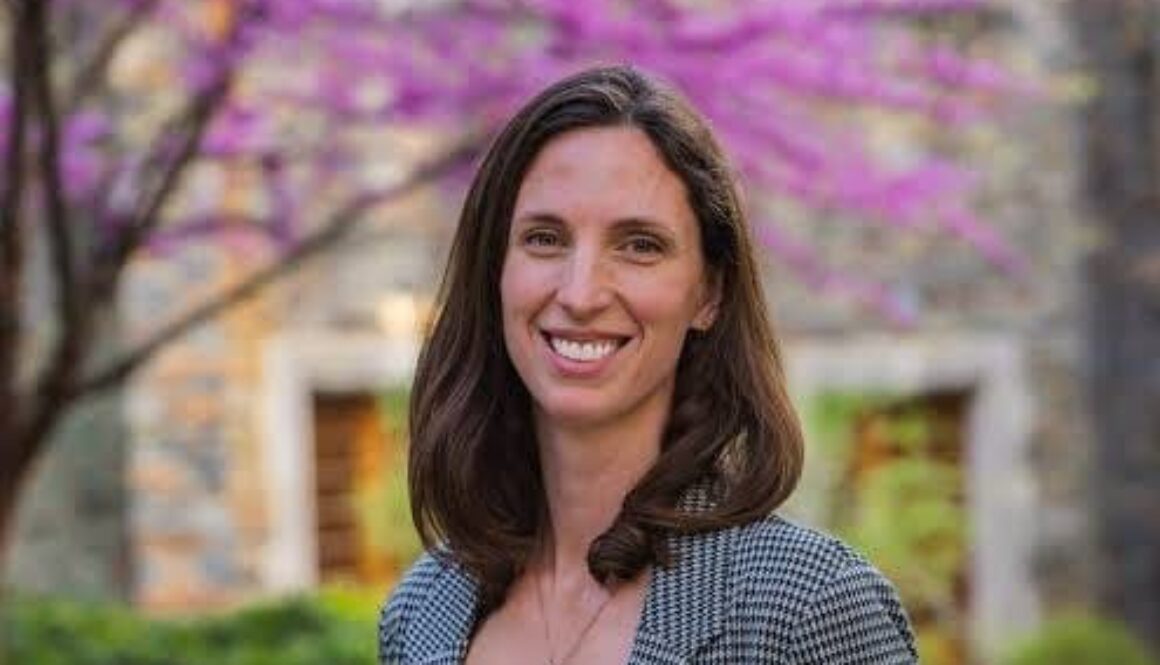
 Kerilyn Schewel, assistant professor of sociology at the University of North Carolina at Chapel Hill, was recently honored with two awards for her book, “Moved by Modernity: How Development Shapes Migration in Ethiopia,” at the American Sociological Association annual meeting. She was selected for both the Best Book Award from the Sociology of Development section and an honorable mention for the International Migration section’s Thomas and Znaniecki Best Book Award. Her book explores why contemporary development is a root cause of global migration and challenges assumptions that we need to “develop” the countries migrants are leaving to address the root causes of migration.
 Lisa Pruitt, Brigitte Bodenheimer Research Scholar and Distinguished Professor of Law at the University of California, Davis, was recently quoted in an Axios article. Titled “The majority-minority shift changing rural America,” the article focuses on the projection of the U.S. to become a “majority minority” country by 2050, while highlighting that this demographic shift has already occurred in many rural areas. An Axios analysis of federal data finds that 403 U.S. counties — roughly 12.8% of the national total — already are majority-minority. As Pruitt notes in the article, these shifts present new challenges for rural courts. Pruitt says the pressure is particularly acute in communities that were already struggling to deliver basic services before being asked to provide interpreters, translated materials and multilingual communication.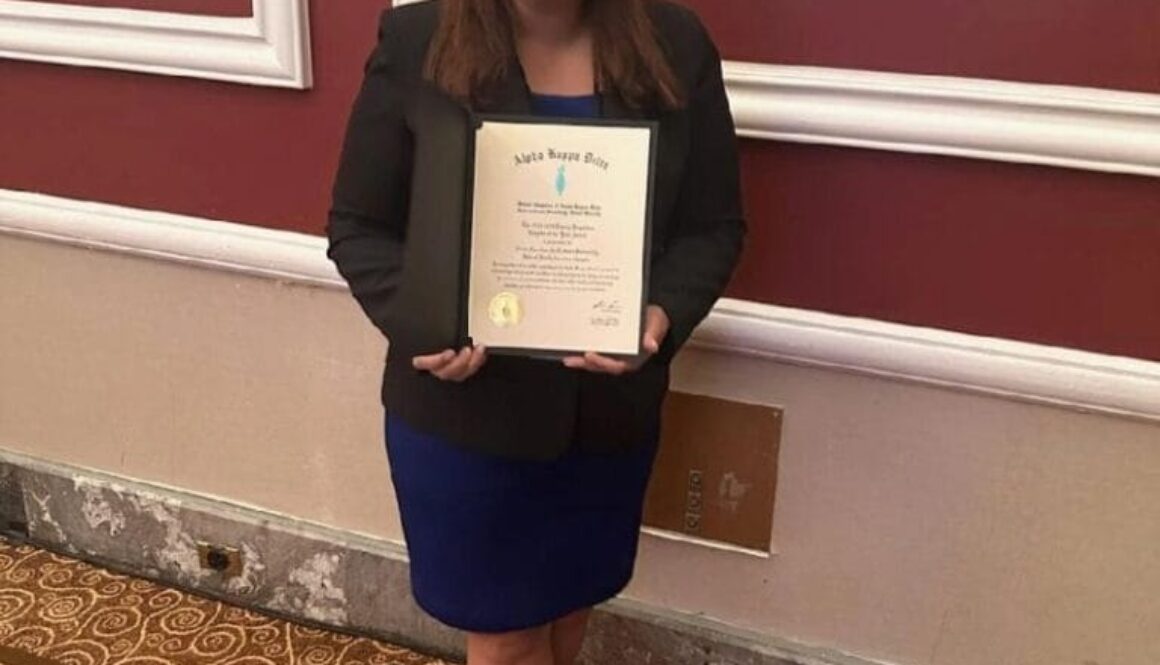
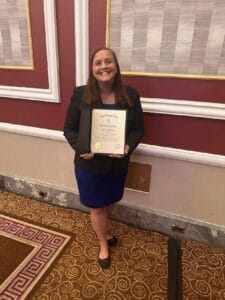 Stephanie Teixeira-Poit, Associate Professor in the Hairston College of Health and Human Sciences and Associate Director of Community Engagement for the Center of Excellence for Integrative Health Disparities and Equity Research at North Carolina Agricultural and Technical State University, recently accepted an award on behalf of the Zeta chapter of Alpha Kappa Delta at the American Sociological Association annual meeting. Alpha Kappa Delta is the international sociology honors society, and Teixeira-Poit serves as chapter representative/advisor to the Zeta chapter of the society.
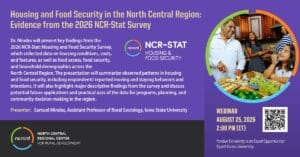 Sam Mindes, Assistant Professor of Rural Sociology at Iowa State University, will be the featured speaker for a North Central Regional Center for Rural Development webinar on Tuesday, August 25th, 2026 at 1pm central time. The webinar is titled “Housing and Food Security in the North Central Region: Evidence from the 2026 NCR-Stat Survey.” Mindes will present key findings from the 2026 NCR-Stat: Housing and Food Security Survey, which collected data on housing conditions, costs, and features, as well as food access, food security, and household demographics across the North Central Region. The presentation will summarize observed patterns in housing and food security, including respondents’ reported moving and staying behaviors and intentions. It will also highlight major descriptive findings from the survey and discuss potential future applications and practical uses of the data for programs, planning, and community decision-making in the region.
 Lijing Gao, Assistant Professor of Agricultural Science Communication at the University of Missouri, recently published an article in The Diplomat. Titled “China Can’t Talk About Birth Rates Without Talking About Rural Pensions,” the article focuses on the need to support elderly adults in China in the context of declining birth rates, especially in rural areas. As Gao notes, the Chinese government is aware of the population problems, but its proffered solutions assume that family planning is primarily shaped by the immediate costs of raising children instead of addressing the needs of older adults. Gao writes, “When older parents lack adequate pension income, adult children become their safety net. That responsibility shapes career choices, savings, marriage decisions, and ultimately whether starting a family feels financially feasible.”
 Tim Slack, professor of sociology at Louisiana State University and president-elect of RSS, was recently interviewed on the show Louisiana Considered for Baton Rouge Public Radio. Slack, who researches social stratification, social demography, and rural sociology and focuses on place and space as axes of difference, spoke about his election to the role, how it relates to LSU and the university’s goals, and his hopes for RSS as the organization seeks to promote researching rural communities and environments. Slack’s recent and ongoing research projects include studies of working poverty and other forms of underemployment; household livelihood strategies and participation in the informal economy; and various aspects of regional inequality.
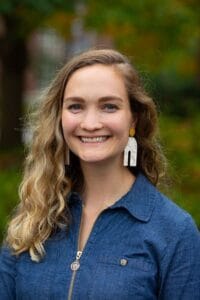 Kristina Brant, assistant professor of rural sociology and Social Science Research Institute co-funded faculty member at Pennsylvania State University, recently published findings with colleagues in the Proceedings of the National Academy of Sciences. The study found that severe flooding may contribute to higher mortality rates from opioid use in rural Appalachia. These results are especially significant as they come as severe floods are increasing in prevalence and severity due to climate change. As Brant notes, “These findings are important because they underscore that the impacts of environmental disasters and extreme weather events are not just immediate — they can continue to impact our health for years to come.” Brant was inspired to conduct this research by her own experiences with Appalachian floods.
 Emma Scott, Director of the Food and Agriculture Clinic and associate professor at Vermont Law and Graduate School, was recently featured on the Vermont Law and Graduate School Hot Topics podcast. The episode was titled “Occupational Hazards in a Warming Climate: Preventing Heat Illness in Agricultural Settings.” Scott’s work focuses on food system workers and food system policy at the federal, state, and local level. Most recently before coming to Vermont Law, she served as the Associate Director of the HLS Food Law and Policy Clinic (FLPC) and a Lecturer on Law at Harvard Law School. At FLPC, Emma primarily led FLPC’s advocacy on farm bill policy, food system workers, and improvement of USDA programs and services.